WP5 Activity: Skill Development
In this section, you will find all activities dedicated to the training and education of the Ukrainian research community in the field of research infrastructures.
RIFF offers a diverse range of opportunities, from exclusive, invitation-only initiatives - such as the Study visits (listed under Developing roadmapping skills and capacity among policy-makers and leaders in Ukraine) to programmes available to the wider community. For example, the Programme in Research Infrastructure Management Fundamentals, which is conducted primarily online and is open to almost any Ukrainian researcher seeking to enhance their knowledge in the area of research infrastructures.
We have prepared a detailed infosheet that describes the upcoming training activities organized by the RIFF project. It should help you determine which training programme best matches your needs.
The following activities are currently relevant:
- Programme in Research Infrastructure Management Fundamentals
Programme in Research Infrastructure Management Fundamentals
About the Programme
The Programme in Research Infrastructure Management Fundamentals has been developed within the RIFF project to strengthen the managerial capacity of Ukrainian Research Infrastructures. It provides participants with the knowledge, skills, and practical tools needed to establish, develop, and manage Research Infrastructures in accordance with European standards and best practices.
The Programme is delivered in English and consists of two learning components:
- an Online learning pathway, open to all participants, comprising self-paced modules, live webinars, and a final assessment leading to the Certificate;
- a series of Hands-on Workshops that provide advanced practical learning for a limited number of participants selected from among the selected based on their active and consistent engagement with the Online Learning Pathway.
Successful completion of the Online Learning Pathway and the final assessment leads to the award of the Certificate in Research Infrastructure Management Fundamentals, issued by the University of Milano-Bicocca.
Application deadline: 15 November 2026
Duration of the programme: January–June 2027
Location:
- Online (Online learning pathway)
- Ukraine (Hands-on Workshops)
Contact email: enrico.guarini@unimib.it
Target participants
The Programme is designed for current and future leaders of Ukrainian Research Infrastructures across all scientific domains. It is particularly suitable for:
- Directors, managers, and coordinators of Research Infrastructures;
- Scientific and administrative staff involved in the governance, operation, and development of Research Infrastructures;
- Researchers preparing to assume management or leadership responsibilities within Research Infrastructures;
- University and research organization staff involved in the planning, governance, operation, or support of Research Infrastructures;
- Policy makers and public officials involved in the governance and development of the Ukrainian Research Infrastructure ecosystem.
The Programme welcomes participants from Research Infrastructures at different stages of development, including both emerging national facilities and well-established infrastructures seeking to strengthen their managerial capacity and integration within the European Research Area.
Target: current and future leaders of Ukrainian research infrastructures (open to all participants)
- Self-paced online modules
- Live Q&A webinars
- Final online assessment
- Certificate

Target: selected RI managers and researchers involved in RIs (limited number of places)
- Hybrid format
- Practical group learning
- Peer exchange
- Selected based on active engagement in the Online Learning Pathway
Research Infrastructure Landscape in Europe
- Introduction to the European Research Area (ERA) and ESFRI
- Overview of RI organisation across the six ESFRI domains
- Domain-specific characteristics, governance models, and services
- Contributions of RIs to scientific excellence and innovation
Operational and business models of Research Infrastructures
- Introduction to the concept of business models in the context of Research Infrastructures
- Key components of RI business models
- Overview of different RI business model typologies
- Balancing openness, excellence, and sustainability
Establishing and Developing Research Infrastructures
- Key steps in setting up an RI
- Governance structures and legal frameworks
- Consortium building and stakeholder engagement
- Development of RI nodes and scaling over time
Access Policy and Service Provision
- Models and access policies to RIs
- User engagement and service design
Learning Format
The Online Learning Pathway is delivered over a six-month period, January–June 2027, and combines flexible self-paced learning with regular live webinars. This approach enables participants to progress through the curriculum at their own pace while benefiting from interaction with European and Ukrainian Research Infrastructure experts throughout the programme.
Self-Paced Learning
-
Pre-recorded lectures delivered through the University of Milano-Bicocca's online learning platform
-
Supporting learning materials and case studies
-
Flexible access to learning resources throughout the six-month online learning pathway
Live Webinars
-
Live sessions (1–2 hours) featuring European and Ukrainian Research Infrastructure experts
-
Discussion of specific management challenges and real-world case studies
-
Interactive Q&A sessions with participants
All live webinars will be recorded and made available through the online learning platform for participants who are unable to attend the live sessions.
Participants are expected to dedicate approximately 2–4 hours per week to self-paced learning throughout the Online Learning Pathway.
Application process
While there are no formal eligibility restrictions, applications will be reviewed by the RIFF project team to ensure consistency with the Programme's target audience and educational objectives.
Timeline
- Submit online application by 15 November 2026 –
- Application review by RIFF Project Team –
- Acceptance notification: 30 November 2026 –
- Access to the learning platform: January 2027 –
Hands-on Workshops
In addition to the online programme, the RIFF project will organise in Ukraine a series of hybrid Hands-on Workshops for a limited number of participants.
The workshops are designed to strengthen practical management skills through interactive sessions, case studies, and peer learning, with a particular focus on developing specific practical skills and needs of RI managers.
Participation in the Hands-on Workshops will be based on participants’ active and consistent engagement in the Online Learning Pathway.
Summer Schools
This section will be filled in soon.
EMMRI Fellowship Programme for Ukrainian Research Infrastructure Managers
The RIFF project will financially support the professional development of Ukrainian research infrastructure (RI) leaders by providing scholarships for up to four high-profile candidates to participate in the 7th edition (2026–2028) of the Executive Master in Management of Research Infrastructures (EMMRI) Programme, delivered by the University of Milano-Bicocca (Italy), one of the RIFF project partners.
About the EMMRI Programme
EMMRI is a specialised executive MBA focused exclusively on the management of Research Infrastructures (RIs). The programme awards 60 ECTS and runs over 18 months, from November 2026 to May 2028.
The curriculum is structured into:
- 12 modules (40 ECTS), each lasting 3 days
- 7 on-campus modules in Milan
- 5 fully online modules
- Field project (20 ECTS)
The programme combines lectures, case study analysis, expert talks from RI leaders, guest speakers, and webinars, offering participants a comprehensive understanding of RI governance, financial sustainability, strategic planning, innovation management, and international cooperation.
The RIFF fellowship for each participant covers attendance at all programme activities, including seven on-campus modules in Milan, transport, accommodation, subsistence, and examination fees.
For participants who are unable to travel outside Ukraine, interactive remote participation will be made possible.
EMMRI webinar with Ukrainian EMMRI alumni
In June 2026, those interested in the EMMRI program had the opportunity to join a webinar with Ukrainian alumni of the program and hear first-hand about their experience, key takeaways, and how EMMRI supported their professional development.
You can access the presentation from the webinar here.
If you would like to learn more, you can also watch the webinar recording below.

Who Can Apply and How?
High-profile science professionals from research infrastructures across all scientific domains, aiming to strengthen their managerial and strategic leadership capacities to lead research infrastructures.
Selection Criteria:
- Relevant professional experience, current position, and clear training needs
- Strong motivation and potentials
- Scientific domain and geographic balance
- Good knowledge of English
Applications must be submitted via the website of the University of Milano-Bicocca. You can find more information here.
Timeline
- Call opens: February 2026
- Application deadline: 31 July 2026
- Decision on acceptance: September 2026
- Programme start: 2-4 December 2026
- Programme end: 12 May 2028
Developing Roadmapping Skills and Capacity Among Policy-Makers and Leaders in Ukraine
The activity comprises two study visits and two workshops. One of the study visits has already taken place. Read more about the visit below.
Study visit in Czechia
During the week of 20 to 24 April 2026, we had the great pleasure of welcoming our Ukrainian colleagues to Brno for the RIFF Study Visits event. The programme brought together 14 representatives of leading Ukrainian institutions for an intensive week, which provided first-hand insight into how leading research infrastructures (RIs) in the European Union (EU) are organised, governed, financed, and strategically developed, as well as how they cooperate with their host institutions.
Day 1: Masaryk University introduction
The programme opened with a welcome by the Rector of Masaryk University, who shared the university’s experience in strategic research development and institutional management.
Later that day, participants visited several research infrastructures at the university campus, where they engaged with senior representatives and explored governance models and operational practices. The programme featured, among others, the Centre of Excellence CREATIC, RECETOX, and CEITEC MU core facilities.


Day 2: CzechGlobe
The second day focused on environmental sciences through a visit to CzechGlobe, the Global Change Research Institute of the Czech Academy of Sciences.
Participants were introduced to a wide range of international research initiatives and infrastructures in which CzechGlobe is involved, including:
- ICOS – Integrated Carbon Observation System
- EUFAR – European Facility for Airborne Research
- AIRLIFTS – European Initiative for Central Access to Airborne Platforms
- DANUBIUS RI – International Centre for Advanced Studies on River-Sea Systems
- ACTRIS – Aerosol, Clouds and Trace Gases Research Infrastructure
- AnaEE ERIC – Analysis and Experimentation on Ecosystems
- eLTER – Integrated European Long-Term Ecosystem, Critical Zone and Socio-Ecological Research Infrastructure
In the afternoon, they visited CEITEC Nano, where they had the opportunity to see the cleanroom facilities and learn about their semiconductor initiatives.


Day 3: Social Sciences and Humanities
Wednesday was dedicated to social sciences and humanities. Representatives from the Faculty of Social Studies, Faculty of Arts, and Faculty of Economics and Administration introduced their respective research infrastructures:
This session highlighted the important role of RIs beyond the natural and technical sciences.
Day 4: National and European Perspectives in Prague
On Thursday, participants travelled to Prague to explore the broader national and EU policy perspective.
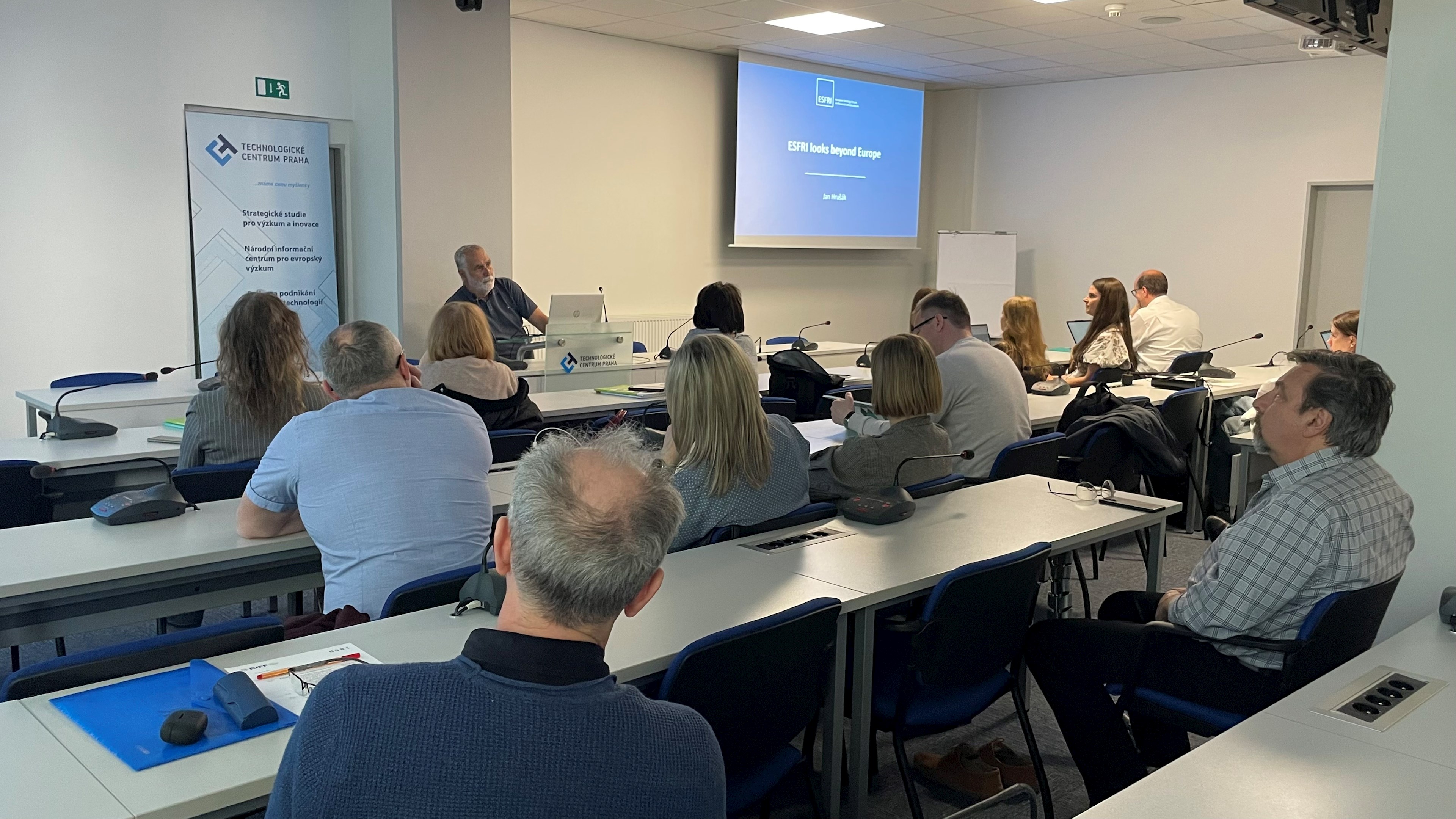
They visited the Technology Centre Prague and the Ministry of Education, Youth and Sports of the Czech Republic. The day concluded with a presentation by Jan Hrušák, Member of the ESFRI Executive Board and Envoy for Research Infrastructures at the Ministry, who shared insights into the development of research infrastructures at both Czech and EU levels.


Day 5: ELI ERIC
The final day of the programme was dedicated to a visit to ELI ERIC, one of Europe’s flagship RIs and a globally recognised centre of excellence in laser science and advanced technologies.


Looking Ahead
We were deeply impressed by the proactivity, enthusiasm, and strong interest shown by our Ukrainian visitors throughout the week. We hope the study visits provided valuable inspiration and practical benefits for their future efforts.
Study visit in Poland
From 21 to 25 September 2026, a 19-member Ukrainian delegation representing 16 organisations visited Warsaw and Kraków as part of the RIFF Study visits to explore how research infrastructures are planned, funded, governed, and operated in Poland.
Days 1-2: National policy and funding for research infrastructures
The first two days in Warsaw focused on national research infrastructure policy, funding, and European cooperation. At the Ministry of Science and Higher Education, the delegation was introduced to the Polish Roadmap for Research Infrastructures and the mechanisms used to support its implementation. Later in the day, the programme also included an introduction to the RIFF project and the Study visit, a presentation on the Ukrainian Science Diaspora, and a round-table discussion bringing together the members of the delegation.
The second day focused on the funding landscape, with visits to the Foundation for Polish Science (FNP) and the National Centre for Research and Development (NCBR), as well as a meeting with the Polish Horizon Europe National Contact Point. Discussions covered FNP funding programmes, the role and responsibilities of NCBR, and opportunities for research infrastructures within Horizon Europe. The delegation also discussed preparations for FP10 and the future EU research and innovation landscape.
Days 3-4: Institutions, the Małopolska Region and core facilities in Kraków
The programme then moved to Kraków, where the focus shifted towards the role of universities and regions in supporting research and innovation. At Jagiellonian University, participants learned about the university’s research policy, as well as its involvement in international university networks. Discussions at the Marshal’s Office of the Małopolska Region focused on regional innovation support, the use of EU funds, and services for investors.
The final part of the visit focused on research infrastructures and their role within wider innovation ecosystems. At SOLARIS, the delegation toured the synchrotron and discussed the role of large-scale, open-access research infrastructures in the European Research Area.The programme also included visits to the Jagiellonian Center of Innovation and the Małopolska Centre of Biotechnology (MCB).
Day 5: Concluding discussions
The programme concluded with a summary of the Study visit and a closing discussion, giving participants an opportunity to reflect on the main insights from the five-day programme.
Takeaways from the Study visit in Poland
Taken together, the programme gave the Ukrainian delegation an opportunity to see how research infrastructure policy is translated into practice, from national strategies and funding instruments to institutional decisions and the operation of individual facilities. The discussions also highlighted the importance of cooperation between national, regional, and institutional actors in supporting the long-term development of research infrastructures.


Ukraine-ERA Research Infrastructure Staff Fellowships
This section will be filled in soon.